I built an AI agent to manage my other agents. For simple tasks, it made things worse.
Share article
Originally published on Medium
The pitch is appealing: talk to one agent, and it manages the rest. Grok’s “Chief of Staff” bots point the same way. Today, using several AI tools makes you the project manager: explaining the task, carrying information between tools, checking the result.

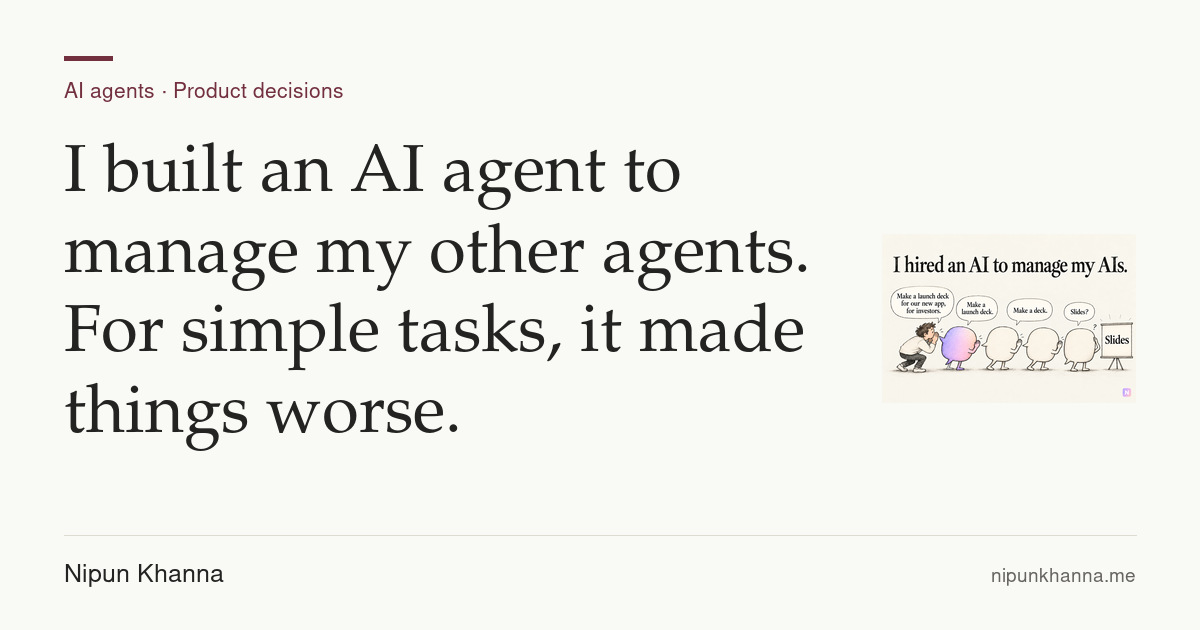
A general purpose bot doing tasks for you is different from a 'coordinating' agent delegating to other specialist agents. Delegation brings a new problem: CONTEXT LOSS. Every handoff is a summary of your request, and a summary is never quite the request.
At NikiStudio.cloud, I built one. A coordinating agent, Niki, briefs specialist agents for slides, forms and design. Then I measured it.
For a single deck, it lost. Going through Niki was slower and cost more, and the copy came out weaker than asking the Slides agent directly. It’s why, for real work, I still go straight to specialists like Codex and Claude.
For work with several parts, it performed better. A campaign needs a deck, a form and a poster that all say the same thing. That’s when coordination is the job.
And its best job was checking. The Slides agent finished a slide and approved its own work. Niki compared it to my request, saw the requested copy was missing, and sent it back.
What I’d take from it:
- Single task? Go straight to the specialist.
- Several parts that must agree? Use a manager that holds your context well.
- Judge the manager by how well it checks the whole result, not just by how much it delegates.
The future may be one agent you talk to. But behind it, specialists will still do the work, and someone has to own the outcome.
What would you hand to an AI manager and what would you always want brought back to you...
#AIAgents #FutureOfWork #ProductManagement