What changes when an agent starts building the slides?
Share article
Originally published on Medium
When we started out in consulting, a large part of an associate’s job happened inside PowerPoint.
You learned the shortcuts, borrowed pages from old decks and spent far too long moving boxes by a few pixels because the slide had to look right. Then came another round of comments and another file called final_v7.
We complained about PowerPoint constantly, but most of us also became strangely attached to it. It was where a week of research became a story. When a slide finally worked, the answer usually felt clearer too.
After building agents for other kinds of creative work, I had to build one for slides too (https://www.nikistudio.cloud ). Part of the reason was personal. After so many years inside PowerPoint, I wanted to see whether I could create a Slides Agent that I would genuinely want to work with.
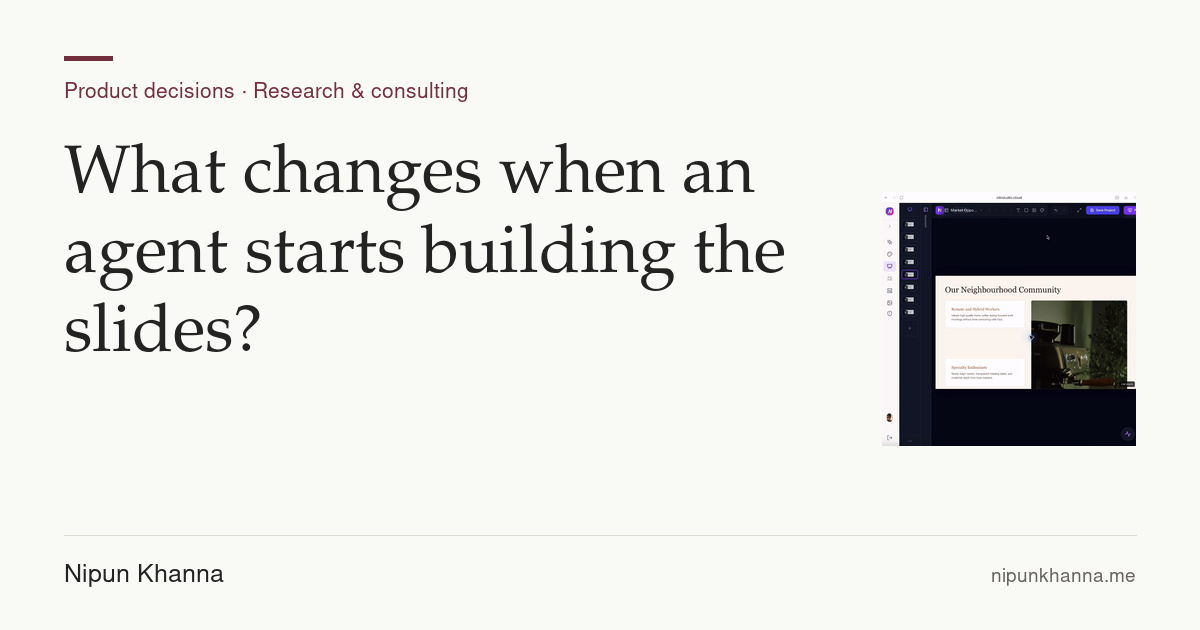
I know Claude and Codex can already create presentations. What I wanted was an agent beside a live canvas, so the agent and the human could work on the same deck together. You give it a brief, and it can research the subject on the web, find relevant media, plan the storyline and build the slides. You can edit the canvas yourself or ask the agent to take another pass.
I built it around a loop architecture rather than a one-shot automation. The agent decides what to do next, uses the appropriate tool, reviews what happened and revises when something is missing. It does not simply produce a deck and stop at the first result.
The more interesting question is what this changes inside Research & Consulting. Associates traditionally learned through the production work itself. Researching the market, arguing about the storyline and rebuilding the same slide five times were frustrating, but they also developed judgment.
If agents take over more of that production, associates might spend less time perfecting every slide and more time checking the evidence, challenging the argument and steering the agent towards a better answer. The risk is that people may accept polished output without understanding how it was produced.
The good part may be that the next generation of associates may spend less time becoming fast at PowerPoint and more time becoming good at working with agents. But their advantage will still come from knowing when the research is weak, when the story does not hold together and when a convincing slide is hiding a poor answer.
I suspect the same shift is coming for analysis and many of the tools we use all day.
The next layer I’m working on at NikiStudio.cloud is agent-to-agent coordination: how one agent can hand work to another without losing the context, evidence or human control. I’ll write about that next.