AI got better at design when it worked in its own language
Share article
Originally posted on X

AI got much better at design this year. Different types of models got there in different ways. Claude Design builds slides and website prototypes through code. Image models, including ChatGPT Images 2.0 and Google’s Nano Banana 2, can put more readable text into posters. Figma and Canva now work with editable layers.
I ran into that difference while building two agents at Niki Studio. One makes designs such as posters. The other makes slide decks. Both produce something visual, but using the same method for both gave me the wrong kind of result for at least one of them.
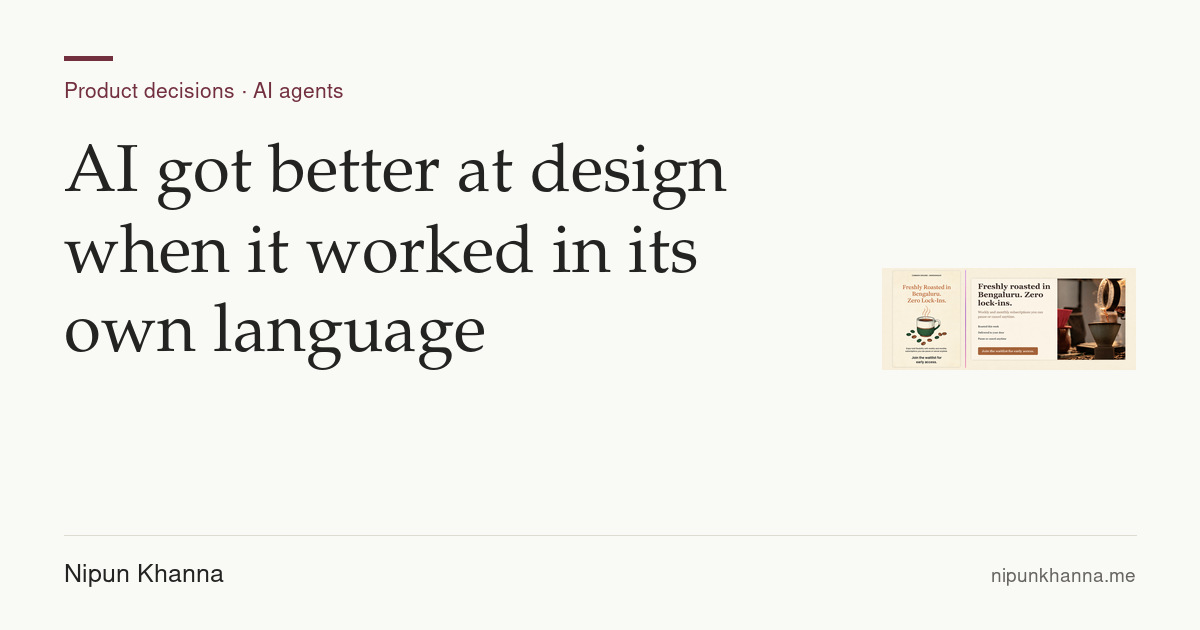
I gave both agents a brief for the same coffee brand. One made a café poster; the other made a launch slide. Looking at them together explains why I ended up with two approaches.
The poster starts as an image
Early on, I had the Design agent arrange the poster itself. It could place the elements, but the results felt safe and flat. An image model made stronger visual choices, so I changed the sequence: the image model establishes the look of the poster, then the agent rebuilds the words as editable text on the canvas.
The poster here leads with an illustrated coffee cup, warm paper and a large headline. Those are the kinds of visual choices I wanted the image model to make. The headline, offer and call to action still need to be changeable. If I want different words, I should be able to edit them without asking the image model to redraw the whole poster.

The slide starts as code
Slides took longer to figure out. I tried several approaches, including generating slides as images. That can give you an attractive page, but a presentation needs its message to hold together: a headline, supporting copy, benefits and a call to action have to fit in a clear order. As the content changes, the layout has to change with it.
I settled on having the Slides agent write HTML and CSS, the code used to build and style web pages. For the coffee launch slide, it could give the headline a strong left column, put the subscription benefits underneath and use a photograph on the right. The words and the arrangement remain part of the slide's structure, so the agent can revise the page rather than redraw a picture of it.

Writing the slide as code has a cost. It uses more tokens than filling in a fixed layout, and a code error can require another pass. I am keeping HTML and CSS because, for the slides I want, that flexibility is worth the extra work.
What the two examples taught me
The poster and the slide share a coffee offer, but they ask different things of the agent. The poster needs visual atmosphere. The slide needs to carry a message in an order someone can follow. The first draft comes from an image model in one case and from code in the other.
I think that is where design is heading. More of the first draft will come from AI, whether it starts as an image or as code. Designers will spend less time building every element from scratch and more time deciding what deserves to stay, what needs changing and whether the work communicates what it should. Producing something polished will get easier. Knowing whether it is the right design will still take judgment.
When you use AI for design, do you care more about the first result or how easily you can change it?