AI Agents Won’t Kill Automation. They’ll Stand on Top of It.
Share article
Originally published on Medium

TL;DR:
- Traditional automation is rigid but reliable (perfect for fixed rules).
- AI agents are adaptive but probabilistic (perfect for complex reasoning).
- The future isn’t one or the other; it’s hybrid systems.
- By 2028, work will shift to agents orchestrating clean automations.
I’ve been meaning to build agentic workflows lately. So I started exploring tools like n8n, Make, Perplexity, and Claude Code. That’s when I thought about this simple but tricky question:
How are “AI automations” different from “AI agents”?
Turns out, there’s more nuance than it seems.
The Deterministic World of Automation
Traditional automation follows fixed logic. It is almost linear in nature. When you set up a workflow in n8n, you’re programming rules:
“When an email with invoice arrives -> save attachment to Google Drive -> send notification”.
You can add AI into this flow. Maybe you have an LLM summarize the email first. But the workflow is still deterministic. You define every step. The system executes with no deviation. It’s reliable with low failure rates.
Quick recap: Automation shines when the process is perfectly understood and the cost of error is high. It follows your exact instructions every time.
The Adaptive World of AI Agents
AI agents work differently. They are autonomous. They can pick their own steps and tools.
When you ask Perplexity to research, you don’t explain how. You simply ask: “What’s the state of AI agents in 2025?”
It plans the research. It chooses sources. It synthesizes and refines the answer as it goes. The AI decides the flow based on your goal.
And the “wow factor” is real. Tools like Claude Code can write codebases, debug errors, and iterate on solutions. Google’s latest Gemini models add even more agentic capabilities. These systems are flexible, adaptive, and impressive.
Quick recap: Agents excel at adaptability, coding, writing, analyzing. They figure out the “how” so you don’t have to.

Where Does Each Fit?
So where does each fit in your stack?
Automations shine when the cost of getting something wrong is high and the process is perfectly understood. If something has to run the same way every time, automation is the sensible option. That’s why critical business systems rely on deterministic logic.
Agents excel at adaptability: coding, writing reports, analyzing information. While automations are rigid, they’re incredibly reliable. Agents may make mistakes, but their strength is in adapting, reasoning, and handling tasks where the path isn’t predefined. And they’re improving every month.
The Future Is Hybrid
The future isn’t automation or agents. It’s hybrid systems.
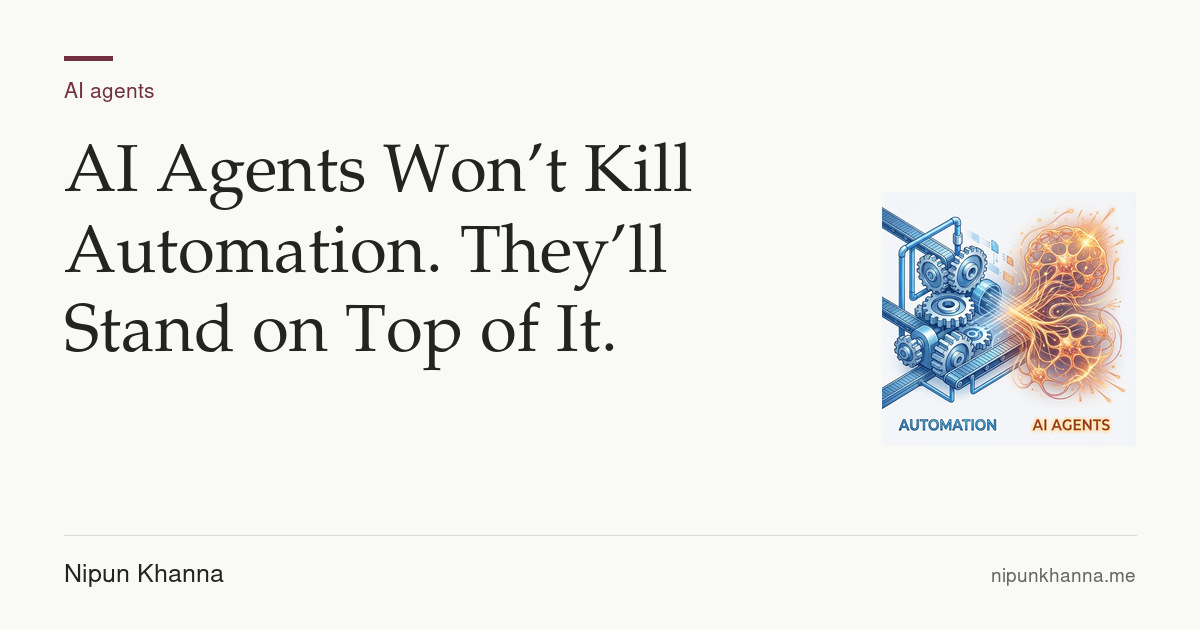
Automation becomes the stable infrastructure. Agents become the adaptive layer on top.
Tools like n8n have already been doing this. They let you embed small “agentic” decisions inside workflows. As systems mature, this will flip. Agentic systems will get better at planning and tool use. Agents will orchestrate the process. Automations will be the tools they call when something needs perfect execution.
Realizing this genuinely changed how I think about AI workflows.
Quick recap: Don’t replace everything with agents. Build clean automations that future agents can rely on as tools.
My Takeaway
By 2028, many of our daily work decisions will quietly shift to agentic AI. But the smartest move isn’t replacing everything with agents. It’s building clean automations that future agents can rely on.
The shift isn’t coming. It’s already here.